Introduction
|
Kingdom: Plantae
Division: Lycophyta Class: Isoetopsida Order: †Lepidodendrales Family: †Lepidodendraceae Genus: †Lepidodendron |
Lepidodendron is an extinct genus of gigantic tree-like vascular seedless plants that densely populated the swampy landscape in the first forests, in the Devonian and Carboniferous periods, approximatedly between 400-300 Mya[1, p615]. They are closely related some much smaller extant species, spikemosses and quillworts.
|
Morphology & Life Cycle
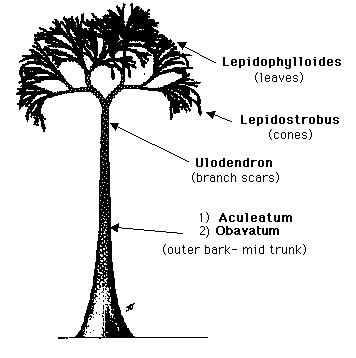
Lepidodendron were sometimes 50m tall[10]. They grew quickly (reaching full size in just 15 years), and their trunks did not branch until they were fully grown. Instead their trunks were green, mostly soft tissue, unlike the hard bark on modern trees[10]. Covering the trunk were leaves, arranged like scales and leavings the diamond shaped 'scars' seen on fossils[11]. Where the plant finally bifurcated at the top, the branches terminated in thin leaves (each supplied by a single vascular bundle), and cones that housed the spores to be released near the end of the plant's life.
|
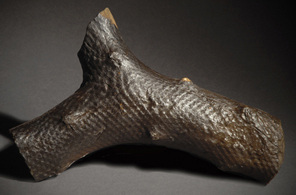
Above: part of a scaly fossilized branch Left: Lepidodendron sporophyte |
Geological Impact
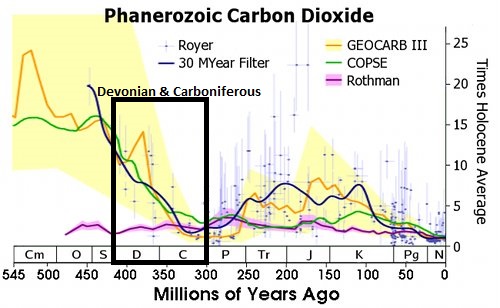
Before vascular plants arose, just 14 million years before the Devonian, fauna on land was restricted to low-lying bryophytes near to the ocean[32]. Vascular plants were able to move inland, and form dense swamp-forests. These areas were very conducive to coal formation, as frequent flooding and other natural processes[31] would bury the plants. As more and more soil accumulated above them, the temperature and pressure converted the dead plant material to coal. This may have been contributed to even more by the microorganisms of the time being much less well adapted to breaking down lignin, which had not been available to them from previous plants[14]. Even more drastically however, emerging vascular plants like Lepidodendron changed had a massive impact on the atmosphere. Having vascular tissue let plants grow tremendously large, allowing for more photosynthetic tissue and an accelerated rate of CO2 removal/O2 gain in the atmosphere. Scientists estimate that CO2 levels dropped by as much as a factor of 5 during the Carboniferous, cooling the atmosphere and causing massive glacier formation, provoking the Karoo Ice Age[1, p615].
|
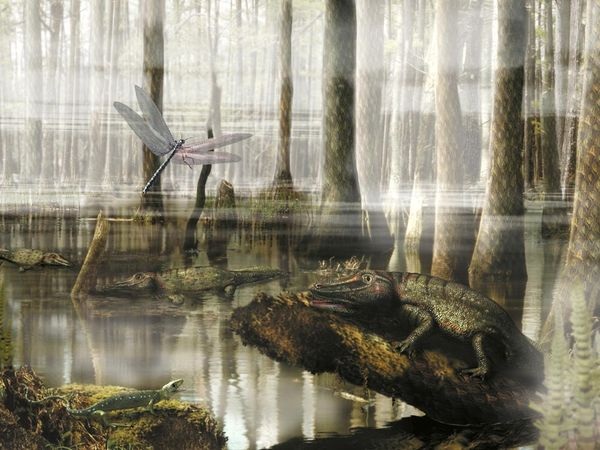
Illustration of a Carboniferous forest with Lepidodendron species
|
Devonian & Carboniferous CO2 levels
|
Extinction
By the end of the Permian, Lepidodendron had died out and been replaced by smaller quillworts. This could be because of competition from large gymnosperms that had been emerging since 360 Mya[1, p618].
References
[1]Campbell & Reece, Biology 8th Edition
[10]http://en.wikipedia.org/wiki/Lepidodendron
[11]http://www.thinktank.ac/page.asp?section=479§ionTitle=Fossil+Branch
[12]http://science.nationalgeographic.com/science/photos/carboniferous-period/
[13]http://www.britannica.com/EBchecked/topic/336789/Lepidodendron
[14]Berner, R. (1999). Atmospheric Oxygen Over Phanerozoic Time. Proceedings of the National Academy of Sciences 96(20): p10955-10957
[31]http://en.wikipedia.org/wiki/Coal#Formation
[32]http://www.devoniantimes.org/
[10]http://en.wikipedia.org/wiki/Lepidodendron
[11]http://www.thinktank.ac/page.asp?section=479§ionTitle=Fossil+Branch
[12]http://science.nationalgeographic.com/science/photos/carboniferous-period/
[13]http://www.britannica.com/EBchecked/topic/336789/Lepidodendron
[14]Berner, R. (1999). Atmospheric Oxygen Over Phanerozoic Time. Proceedings of the National Academy of Sciences 96(20): p10955-10957
[31]http://en.wikipedia.org/wiki/Coal#Formation
[32]http://www.devoniantimes.org/
